
Sketch Engine can compare corpora in the same language by comparing attributes (usually word forms or lemmas) in the corpora. A similarity score is computed indicating to which extent each pair of corpora is similar or different. A score of 1 indicates identical corpora. The higher the score, the more different the corpora are.
Users can compare preloaded corpora as well as their own user corpora.
Preliminary considerations
There is no magic button in Sketch Engine to perform an overall comparison taking into account all the corpus feature. Therefore, it is best to start by thinking about what should be compared:
Sizes – to compare the number of sentences, documents, sentence length, corpus size, go to the corpus info page of each corpus.
Vocabulary – the Keywords and terms tool may be the best place for this. Set one corpus as focus corpus and the other one as reference corpus and see how the vocabulary differs.
Grammar – possibly, the concordance with CQL searches is the place to do this. Search for the grammar structures in question in each corpus.
It may be necessary to devise the whole methodology of the corpus comparison task. There is no magic button to perform complex comparison automatically.
How to compare corpora
This compare corpora tool computes a similarity score based on the comparios of words or lemmas that each corpus contains. For other comparisons, see PRELIMINARY CONSIDERATIONS above.
(1) go to SELECT CORPUS  – Advanced tab – COMPARE CORPORA

(2) select the language and set the attribute
only corpora in the same language can be compared
the attribute defines how to compare, e.g. lemma will ignore the different word forms of the same word
(3) select from the preloaded, user, or shared corpora to compare
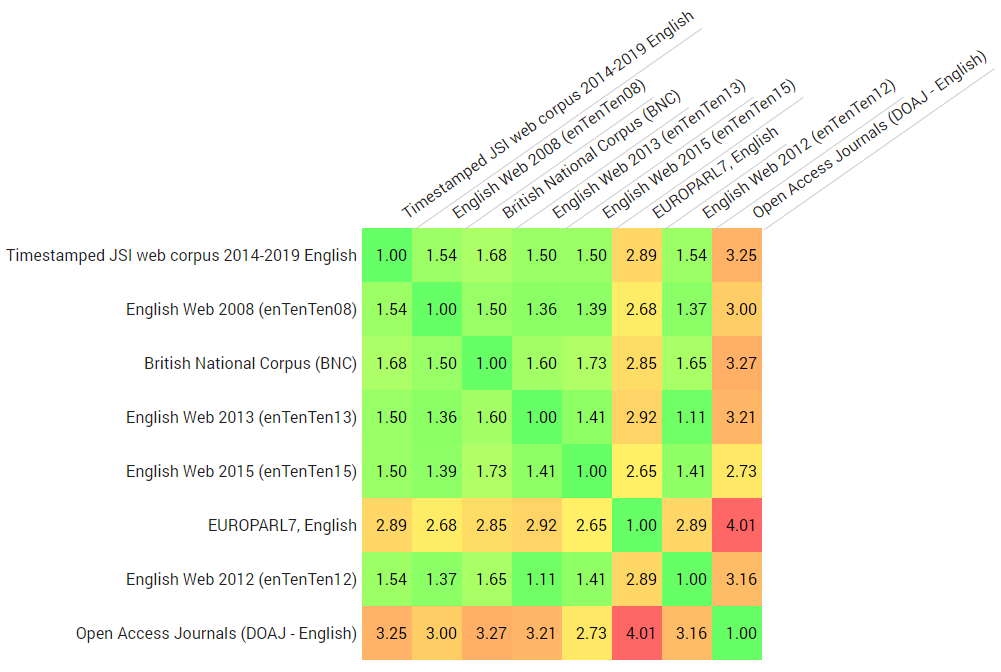
(4) the result will be displayed in a comparison chart
Understanding the result
- The value of 1 indicates identical corpora.
- The higher the score, the greater the difference between corpora.
- It is not possible to tell which value indicates simillar corpora and and which value indicates different corpora.
- The sore can only be used for comparing two or more pairs of corpora. For example, it will show that copora 1 and 2 are more similar than corpora 2 and 3.
- The score does not give clues to what exactly is different between the corpora. Since the comparison is done on tokens, the score is not affected by sentence length, number of documents, corpus size or grammatical features.
- The scores are clickable and connected to the relevant word lists of the two selected corpora.
3 or more corpora
Because of how the compare corpora tool works, it only makes sense to include at least 3 corpora in the comparison. The tool will then tell you, for example, that 1 and 2 are more similar than 2 and 3.
The tool will produce a score even if only 2 corpora are selected. However, it only makes sense if you have a score computed previously for a different pair of corpora. Then you can take the score for the new pair and compare it to the previsouly computed score for the other pair.
Corpus comparison alternative
Two corpora can also be compared based on keywords and terms extracted from them. Set one corpus as the focus corpus and the other as the reference corpus.
A comparison of selected English corpora in Sketch Engine
The corpus comparison result shows that all English web corpora in Sketch Engine have very similar content, while the DOAJ corpus is notably different. The EUROPARL corpus of speeches in the European Parliament is very different from the DOAJ corpus.
How does comparing work?
The following process is used to compare every two corpora in the selection. Corpora can be compared using any attribute. This example uses attribute: word.
- Sketch Engine identifies 5,000 most frequent words in corpus1 and 5,000 in corpus2.
- The two lists are combined into one and duplicates are removed so that each word only appears once.
- The keyness score for every word is computed. The corpus with a higher relative frequency of the word is set as the focus corpus. The corpus with a smaller relative frequency of the word is used as the reference corpus. Thus, the resulting number is always more than 1 or 1 in case the frequency is the same.
- The 500 words with the highest keyness score are identified.
- The arithmetic mean (average) is calculated from the keyness scores of the top 500 words. The result expresses the similarity of the corpora. This is the number displayed in the chart on the corpus comparison result screen.
Glossary
arithmetic mean (average) – the sum of a collection of numbers divided by the count of numbers in the collection
Bibliography
Kilgarriff, A. (2001). Comparing corpora. International journal of corpus linguistics, 6(1), 97-133.