Hindi Trends corpus: a daily-updated monitor corpus of news articles
The Hindi Trends corpus is a Hindi monitor corpus made up of news articles and other sources that are regularly updated from their RSS feeds (newsfeeds). The Hindi trends corpus is updated daily with new texts and grows by about 2 million words each day. These regular updates enable you to use the diachronic analysis tool including the timeline show_chart function and study word usage changes. This timestamped corpus covers the period from 2025 to the present time. The total size of the Hindi Trends corpus is 230 million words (as of January 2026).
Part-of-speech tagset
This Hindi Web corpus was part-of-speech tagged by Siva Reddy’s tagger using the IIIT tagset for Indian languages.
How is the Hindi Trends corpus updated?
New texts are downloaded every four hours. The corpus is updated every Tuesday and Friday when all texts downloaded until the previous day are added to the corpus. Duplicate and near-duplicate texts within the same month are removed, but they are kept in different months, e.g. if the same text appears in June twice, only one instance is kept. If the same text appears once in June and once in July, both are kept.
Search the Hindi Trends corpus
Sketch Engine offers a range of tools to work with this Hindi Trends corpus from news articles.
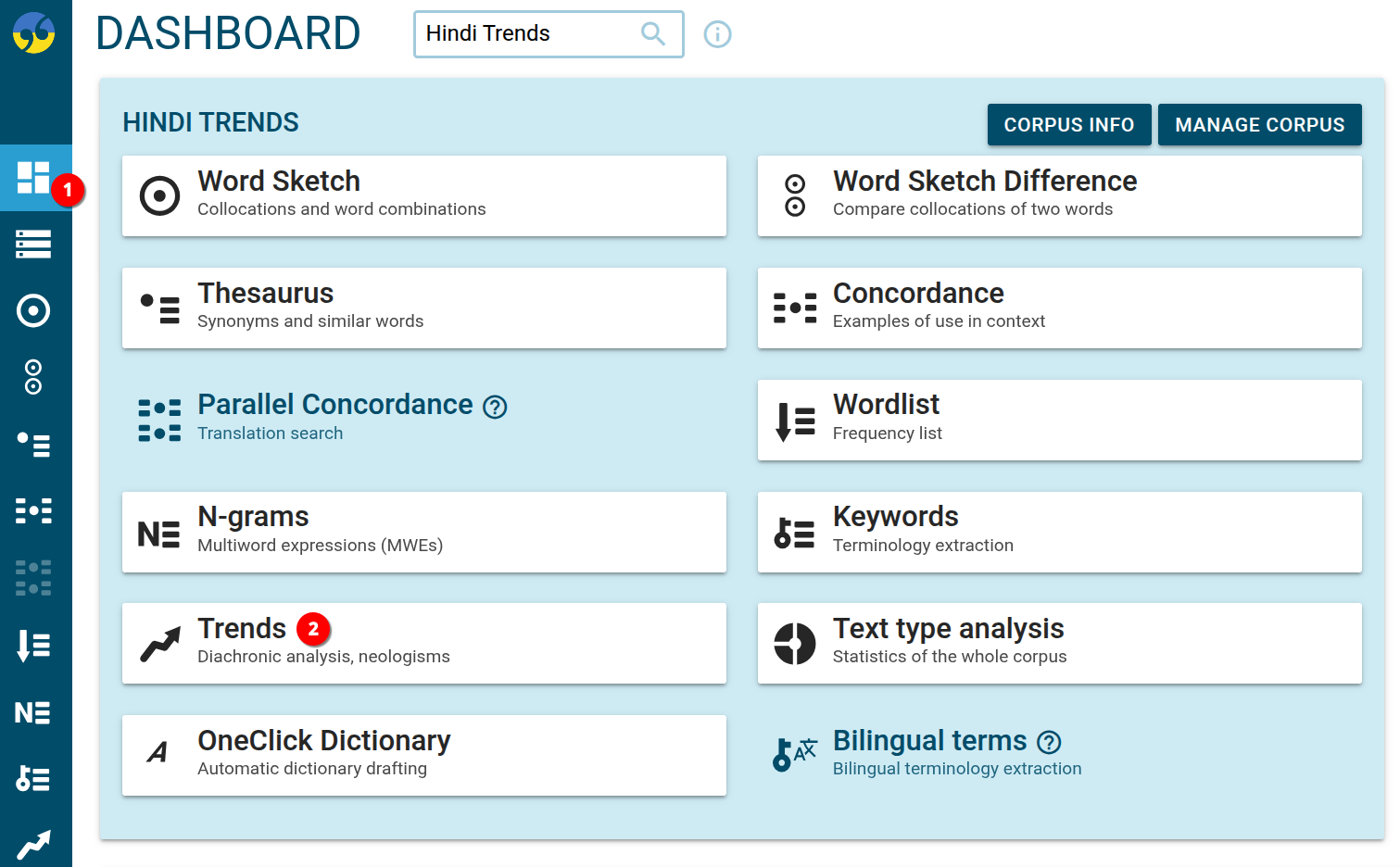
Where to find Trends
The texts in the corpus are timestamped which allows users to use Trends, the diachronic analysis tool for detecting neologisms and studying word usage changes.
Tools to work with the Hindi Trends corpus
A complete set of tools is available to work with this Hindi Trends corpus from news to generate:
- word sketch – Hindi collocations categorized by grammatical relations
- thesaurus – synonyms and similar words for every word
- keywords – terminology extraction of one-word units
- word lists – lists of Hindi nouns, verbs, adjectives, etc. organized by frequency
- n-grams – frequency list of multi-word units
- concordance – examples in context
- trends – diachronic analysis automatically identifies neologisms and changes in use
- text type analysis – statistics of metadata in the corpus
Bibliography
Corpus building
SUCHOMEL, Vít. Better Web Corpora For Corpus Linguistics And NLP. 2020. Available also from: https://is.muni.cz/th/u4rmz/. Doctoral thesis. Masaryk University, Faculty of Informatics, Brno. Supervised by Pavel RYCHLÝ.
Jakubíček, M., Kilgarriff, A., Kovář, V., Rychlý, P., & Suchomel, V. (2013, July). The TenTen corpus family. In 7th International Corpus Linguistics Conference CL (pp. 125-127).
Suchomel, V., & Pomikálek, J. (2012). Efficient web crawling for large text corpora. In Proceedings of the seventh Web as Corpus Workshop (WAC7) (pp. 39-43).
Trends – diachronic analysis
Adam Kilgarriff, Ondřej Herman, Jan Bušta, Pavel Rychlý and Miloš Jakubíček. DIACRAN: a framework for diachronic analysis. In Corpus Linguistics (CL2015), United Kingdom, July 2015.
Ondřej Herman and Vojtěch Kovář. Methods for Detection of Word Usage over Time. In Seventh Workshop on Recent Advances in Slavonic Natural Language Processing, RASLAN 2013. Brno: Tribun EU, 2013, pp. 79–85. ISBN 978-80-263-0520-0.
Genre annotation
SUCHOMEL, Vít. Genre Annotation of Web Corpora: Scheme and Issues. In Kohei Arai, Supriya Kapoor, Rahul Bhatia. Proceedings of the Future Technologies Conference (FTC) 2020, Volume 1. Vancouver, Canada: Springer Nature Switzerland AG, 2021. s. 738-754. ISBN 978-3-030-63127-7. doi:10.1007/978-3-030-63128-4_55.
Use Sketch Engine in minutes
Generate collocations, frequency lists, examples in contexts, n-grams or extract terms. Use our Quick Start Guide to learn it in minutes.